For FSK physical layer Carrier Start/Stop/Decay test, a RTS from the DUT HART modem is always necessary to indicate the start/end point of the carrier signal. See test setup in TT20002.
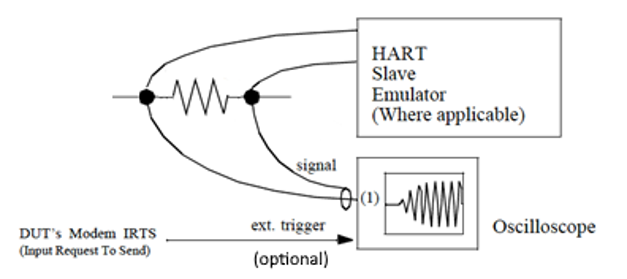
However, for some implementations the RTS would not be available, then the trigger shall be set accordingly to capture the start or the end of the DUT message as described below:
Carrier Start without Access to RTS
- Connect one channel of the scope across the test resistor.
- Note the number of preambles the DUT transmits N (included in command 0 response or declared by manufacturer for host/master devices from configuration).
- Adjust the output of the unit under test to mid-scale output.
- Invoke a command from the communications device (the repetitive command 0 with polling address 0).
- Capture the start of the message including the preambles and the delimiter from the DUT.
- Count the number of preambles n that are seen exceeding 120mVpp before the delimiter. N-1 ≤ n ≤ N.
- Ensure that no carrier above the noise floor is seen for more than 11 bit times before the first preamble exceeding 120mVpp
Carrier Stop/Decay without Access to RTS
- Connect one channel of the scope across the test resistor.
- Adjust the output of the unit under test to mid-scale output.
- Note the check byte that results in the DUT message CHK (e.g. by connecting Hsniffer).
- Invoke a command from the communications device (the repetitive command 0 with polling address 0).
- Capture the end of message from the DUT with at least the check byte and the carrier decay
- Locate the check byte CHK and its stop symbol.
- Measure the time tcoff from the end of the stop symbol until the signal is below the noise floor. toff ≤ 11 bit times
Was this article helpful?
That’s Great!
Thank you for your feedback
Sorry! We couldn't be helpful
Thank you for your feedback
Feedback sent
We appreciate your effort and will try to fix the article